
By Renne Domingos
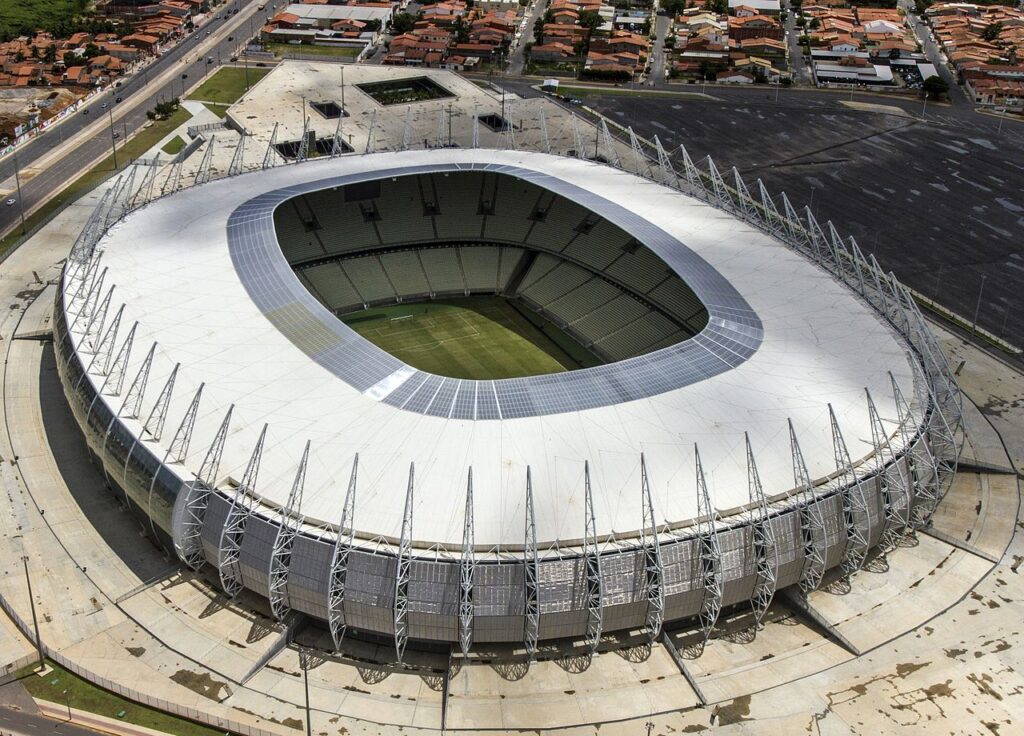
The Castelão is the main sporting venue of the North East state of Ceará (Photo: By the Government of Brazil – World Cup Portal)
The Estádio Governador Plácido Aderaldo Castelo—better known as Arena Castelão—is one of Brazil’s leading football stadiums. Located in Fortaleza, in the North East state of Ceará, it was inaugurated on November 11, 1973, by then-governor César Cals de Oliveira. The opening match was the famous Clássico Rei—the state’s biggest rivalry between Ceará and Fortaleza—which ended in a 0–0 draw before an estimated crowd of 70,000, with the distinguished presence of Leônidas da Silva, the “Black Diamond.”
The construction of Arena Castelão and its importance to sport
Since the late 1960s, the state government had shown interest in building an Olympic stadium capable of hosting major sporting events. A search for suitable land in Fortaleza followed, eventually identifying an area owned by Santa Casa de Misericórdia, which was purchased for 400,000 cruzeiros.
With Brazil hosting the 2013 Confederations Cup and the 2014 World Cup, Castelão underwent an extensive renovation to meet international standards and host Brazilian national team matches. The works modernized the roof and parts of the stands, bringing fans closer to the pitch. An investment of 518 million reais increased capacity from 60,326 to 63,903 spectators. Veja magazine highlighted Castelão as the “only stadium” of the World Cup with financial execution deemed adequate.
Arena Castelão: Stage of historic club and national team matches
As Ceará’s main sporting venue, Castelão has hosted major games that shaped its history. A recent example was Ceará’s 1–0 win over América-MG in the 37th round of the 2024 Série B, which set the post-renovation attendance record with 63,908 fans. On the international stage, Fortaleza drew 60,451 spectators for its 2–0 victory over Corinthians in the 2023 Copa Sudamericana.
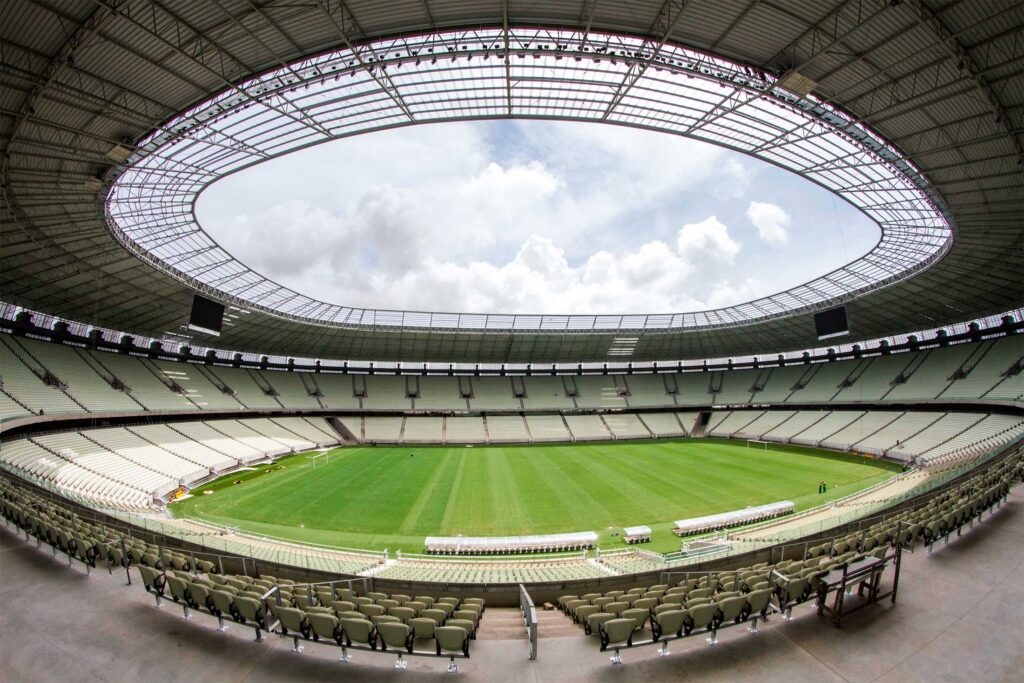
The stadium hosted six matches in the 2014 FIFA men’s World Cup, including a quarterfinal (Photo: @Arena Castelão/X)
Arena Castelão also hosted key FIFA competitions held in Brazil over the past decade. During the 2013 Confederations Cup, the stadium welcomed three matches, including Brazil’s 2–0 win over Mexico with goals from Neymar and Jô, as well as a thrilling semifinal between Spain and Italy decided on penalties in Spain’s favor. These matches reinforced Castelão’s status as one of the country’s premier stadiums, capable of staging top-tier international fixtures.
At the 2014 World Cup, Arena Castelão hosted six matches: four in the group stage, one in the round of 16, and one quarterfinal. Fortaleza stood out as the only city to host two matches featuring the Brazilian national team, including a 0–0 draw against Mexico and a 2–1 victory over Colombia, with goals by Thiago Silva and David Luiz, securing Brazil’s place in the semifinals.
Arena Castelão: A venue for major cultural events
Beyond football, Arena Castelão has also established itself as a significant venue for cultural and historic events. On July 9, 1980, it hosted the National Eucharistic Congress, attended by Pope John Paul II and drawing a crowd of more than 120,000 people. The event also featured the participation of singer Luiz Gonzaga, the “King of Baião.”
The stadium has likewise been the stage for memorable concerts, welcoming major artists such as Mamonas Assassinas, Xuxa, and Paul McCartney. These events highlight Castelão’s versatility, extending beyond sport to become a symbol of culture and celebration in Ceará—one that brings together massive crowds for truly unique experiences.