
By Renne Domingos
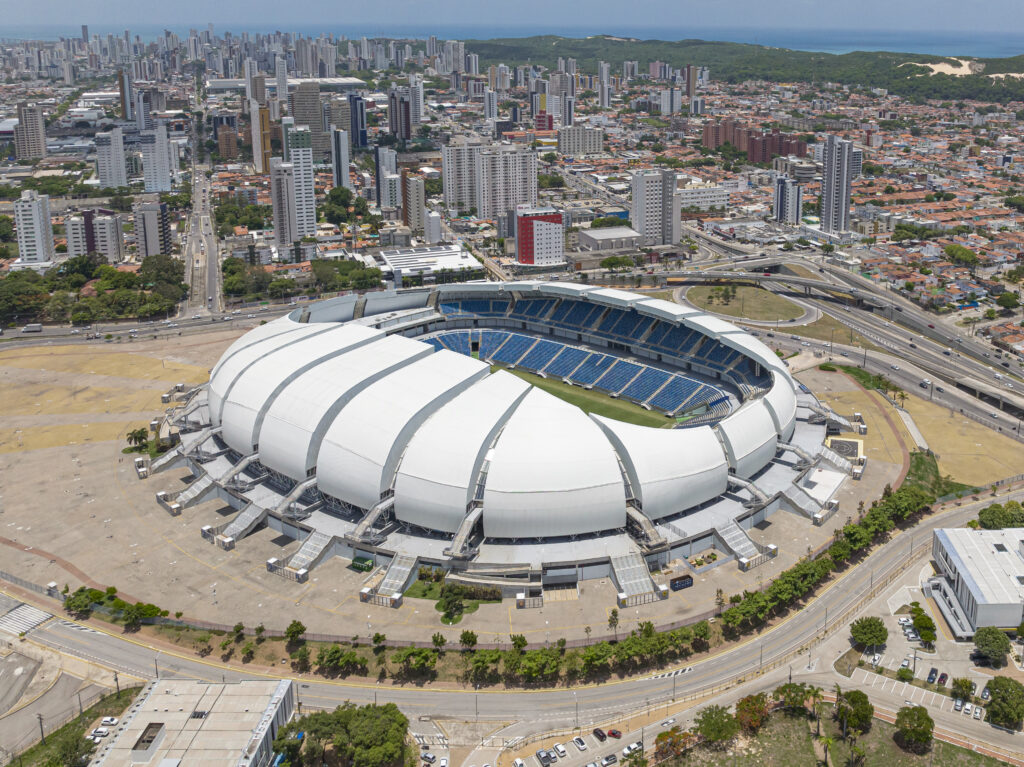
Arena das Dunas was one of the stadiums designed to host matches of the 2014 FIFA World Cup in Brazil, located in the state of Rio Grande do Norte. Construction lasted around two and a half years, and the venue was officially inaugurated on January 22, 2014. In addition to hosting major sporting competitions, the stadium was also conceived as a multi-purpose complex, prepared to receive cultural, corporate, and entertainment events, consolidating itself as an important leisure and social space in the capital, Natal.
Arena das Dunas at the 2014 World Cup
The stadium in Natal hosted four World Cup matches: Mexico vs. Cameroon; Ghana vs. USA; Japan vs. Greece; and Italy vs. Uruguay – the latter two featuring former world champions. In the match between Italy and Uruguay, fans witnessed in person one of the most iconic moments in World Cup history: Luis Suárez’s infamous “bite” on defender Giorgio Chiellini. The incident led to the Uruguayan striker being banned from the competition, receiving a nine-match suspension from international games and a four-month ban from club football.
Largest attendances at Arena das Dunas
Considering official matches only, the game with the highest attendance was América-RN vs. Flamengo, in the 2014 Copa do Brasil, with 30,575 spectators. It is followed by América-RN vs. Pouso Alegre, in Brazil’s Série D, with 30,509 fans, and América-RN vs. Bolivia, in the 2018 World Cup qualifiers, with 30,087 spectators.
When the ball stops rolling, business begins
Currently, Arena das Dunas has been undergoing transformations in its internal spaces with the aim of becoming a hub for corporate and multi-purpose events, not only for Rio Grande do Norte but for the entire Northeast region, especially during periods without football matches. This initiative is part of a management strategy designed to expand the stadium’s use cases, diversify revenue streams, and strengthen its economic sustainability.
With the goal of balancing cash flow and reducing financial imbalance – using football as a foundation while expanding commercial opportunities – the stadium’s luxury boxes have gone through a redefinition process. What was once intended solely for matchday use has been converted into permanent commercial spaces, giving rise to coworking areas, clinics, cafés, ice cream shops, and other services. The proposal is to make Arena das Dunas self-sustainable, as financial statements from previous years indicated losses and the need for a new economic management model.