
By Helena Victoretti
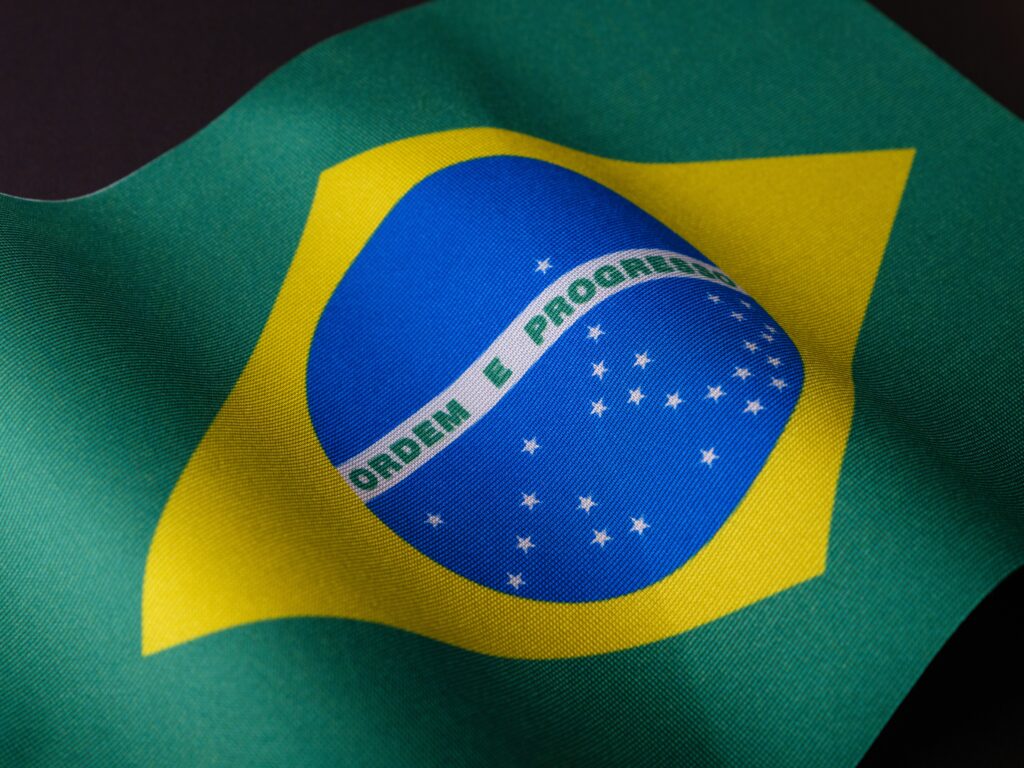
Pelé, Ronaldo, Ronaldinho Gaúcho, Romário and Garrincha are just some of the names to have starred in Brazil’s colours (Photo: enginakyurt)
The Brazilian National Team is the most successful in world football. It is the only five-time World Cup champion (1958, 1962, 1970, 1994 and 2002) and the only nation to have competed in every edition of the tournament, with 22 appearances between 1930 and 2022. Throughout this victorious journey, brazilian national team players have shaped an identity defined by diverse talent, technical creativity and a leading role on the global stage.
The history of the Brazilian National Team
The Brazilian National Team was officially formed on July 21, 1914. Playing at the Fluminense Football Club stadium on Rua das Laranjeiras in Rio de Janeiro, Brazil defeated England’s Exeter City F.C. by 2–0.
The first professional match of the Brazilian National Team featured some of the era’s standout players, including Marcos de Mendonça, Friedenreich, Abelardo De Lamare, Rubens Salles and Sylvio Lagreca.
Exeter City F.C. was a third-division English club touring South America at the time. Despite the visitors’ higher level of professional experience compared to the newly formed Brazilian side, goals from Oswaldo Gomes and Osman marked the beginning of what would become a winning legacy for the Canarinho.
Brazil’s first trophies came early in its history. Just two months after its debut, the team lifted its first title by defeating Argentina in the Copa Rocca.
Continental recognition, however, arrived five years later, when brazilian national team players overcame Uruguay to claim the South American Championship, a defining moment in the consolidation of Brazil as the “country of football.”
Match report — Brazil’s first official game
BRAZIL 2 x 0 EXETER CITY F.C. (ENG)
Date: July 21, 1914
Venue: Fluminense Football Club ground, Rua das Laranjeiras, Rio de Janeiro
Attendance: Estimated 5,000
Goals: Oswaldo Gomes and Osman (BRA)
BRAZIL: Marcos de Mendonça (Fluminense-RJ), Píndaro (Flamengo-RJ) and Nery (Flamengo-RJ); Sylvio Lagreca (AA São Bento-SP), Rubens Salles (Paulistano-SP) and Rolando (Botafogo-RJ); Abelardo (Botafogo-RJ), Oswaldo Gomes (Fluminense-RJ), Friedenreich (Ypiranga-SP), Osman (América-RJ) and Formiga (Ypiranga-SP).
Coaching staff: Sylvio Lagreca and Rubens Salles
EXETER CITY: Reginald Loram, Jack Fort and Samuel Strettle; Jimmy Rigby, James Lagan and Augustus Hardin; Harold Holt, Fred Whittaker, William Hunter, William Lovett and Fred Goodwin
The kits
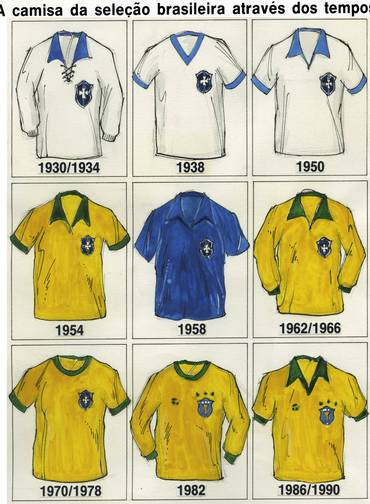
Brazil’s national football team’s kits through different eras (Photo: Agência O Globo)
It may seem ironic, but the iconic yellow kit of the “Canarinho” did not exist when the National Team was founded. Initially, Brazil played in white, avoiding association with any domestic club.
In 1953, following the painful defeat in the 1950 World Cup, the newspaper Correio da Manhã, in partnership with the Brazilian Sports Confederation (CBD), launched a competition to redesign the national kit.
One of the contest’s requirements was the inclusion of all four colors of the Brazilian flag to strengthen national identity. With more than 300 submissions, the winning design came from Aldyr Garcia Schlee, who created the now-famous yellow shirt paired with blue shorts.
Today, the “Amarelinha” stands as one of the strongest symbols of football artistry and the enduring legacy of the Brazilian National Team, recognized worldwide as a benchmark in the sport.
Brazil at the FIFA World Cup
“Everyone tries, but only Brazil is five-time champions.” The chant coined by Brazilian fans over two decades ago remains accurate despite the recent title drought. No other national team has won five World Cups or participated in every edition of the tournament.
1) 1958 FIFA World Cup
The 1958 World Cup took place in Sweden between June 8 and 29, featuring 16 teams. It was here that Brazil claimed its first world title, ending an era of near-misses and frustration.
Brazil advanced from the group stage after defeating Austria and the Soviet Union and drawing with England. In the knockout rounds, the team eliminated Wales in the quarterfinals and France in the semifinals.
The final was held in Stockholm against the host nation. Sweden opened the scoring, but Brazil responded before halftime and took control of the match. In the second half, technical superiority was evident, resulting in a 5–2 victory.
Goals were scored by Vavá (2), Pelé (2) and Zagallo (1). At just 17 years old, Pelé was one of the tournament’s standout players, alongside Garrincha, Didi and Vavá.
2) 1962 FIFA World Cup
The 1962 World Cup was held in Chile between May and June and secured Brazil’s second consecutive title. Despite physical setbacks during the competition, the team demonstrated collective strength and technical depth.
Brazil defeated Mexico and Spain in the group stage and lost to Czechoslovakia. Pelé suffered an early injury, paving the way for Garrincha to emerge as the tournament’s central figure.
In the knockout rounds, Brazil eliminated England and Chile before facing Czechoslovakia again in the final, played in Santiago. Once more, the opponent struck first.
With goals from Amarildo (2) and Vavá (1), Brazil won 3–1 to claim its second world title. Garrincha finished as one of the tournament’s top scorers and the campaign’s standout player.
3) 1970 FIFA World Cup
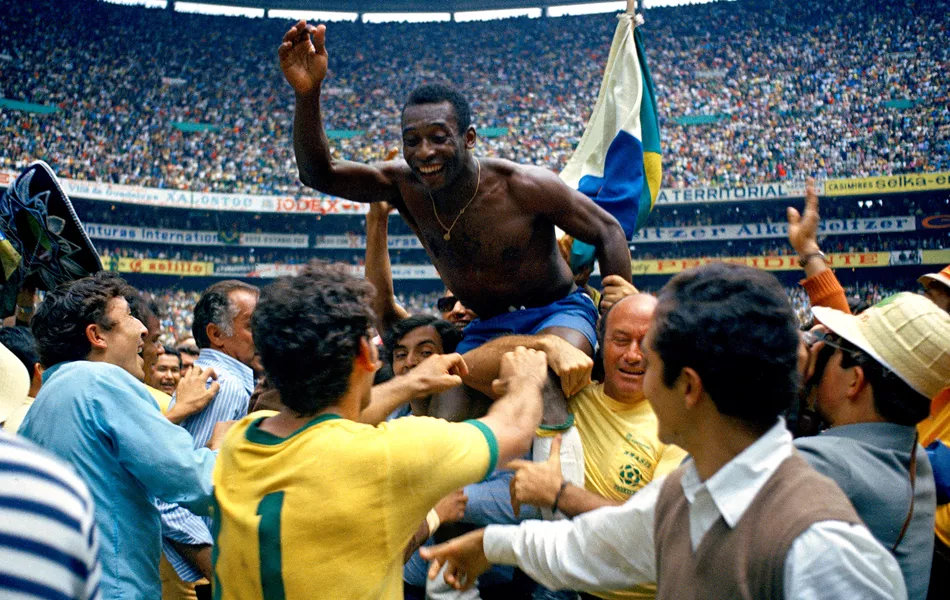
Pelé remains the only player in history to have won three men’s FIFA World Cups (Photo: FIFA)
Widely regarded as the greatest team of all time, Brazil secured its third World Cup title in 1970, in Mexico.
The campaign was flawless from the group stage, with victories over Czechoslovakia, England and Romania. In the knockout rounds, Brazil defeated Peru and Uruguay before meeting Italy in the final.
The decisive match took place at the Azteca Stadium in Mexico City. Brazil dominated and delivered a historic 4–1 victory.
Goals came from Pelé, Gérson, Jairzinho and Carlos Alberto Torres. Jairzinho scored in every match of the tournament, while Pelé became a three-time world champion.
4) 1994 FIFA World Cup
After a 24-year wait, Brazil returned to the top of world football at the 1994 World Cup in the United States.
The team delivered a consistent campaign, progressing through the group stage and eliminating the Netherlands and Sweden in the knockout rounds. The final was played against Italy at the Rose Bowl in Pasadena.
The match ended 0–0 after regular time and extra time, marking the first World Cup final to be decided on penalties.
Brazil won 3–2 in the shootout after Roberto Baggio missed Italy’s final kick. Romário and Bebeto were the tournament’s standout performers, leading Brazil to its fourth title.
5) 2002 FIFA World Cup
Brazil’s fifth World Cup title came in 2002, co-hosted by South Korea and Japan.
With a perfect campaign, Brazil won all its matches. After defeating Turkey, China and Costa Rica in the group stage, the team eliminated Belgium, England and Turkey again to reach the final.
The final was played against Germany in Yokohama. After a balanced first half, Brazil decided the match in the second half.
Ronaldo scored both goals in a 2–0 victory, finishing as the tournament’s top scorer with eight goals. Alongside him, Rivaldo, Ronaldinho Gaúcho and Cafu were among the key Brazilian national team players of the tournament.
All titles won by the Brazilian National Team
FIFA World Cup (5): 1958, 1962, 1970, 1994, 2002
Copa América (9): 1919, 1922, 1949, 1989, 1997, 1999, 2004, 2007, 2019
FIFA Confederations Cup (4): 1997, 2005, 2009, 2013
Olympic Games (2 Gold Medals): 2016 (Rio), 2020 (Tokyo)
Pan American Football Championship (2): 1952, 1956
Pan American Games (5): 1962/63, 1974/75, 1978/79, 1986/87, 2022/23