
By Denis Ninzoli
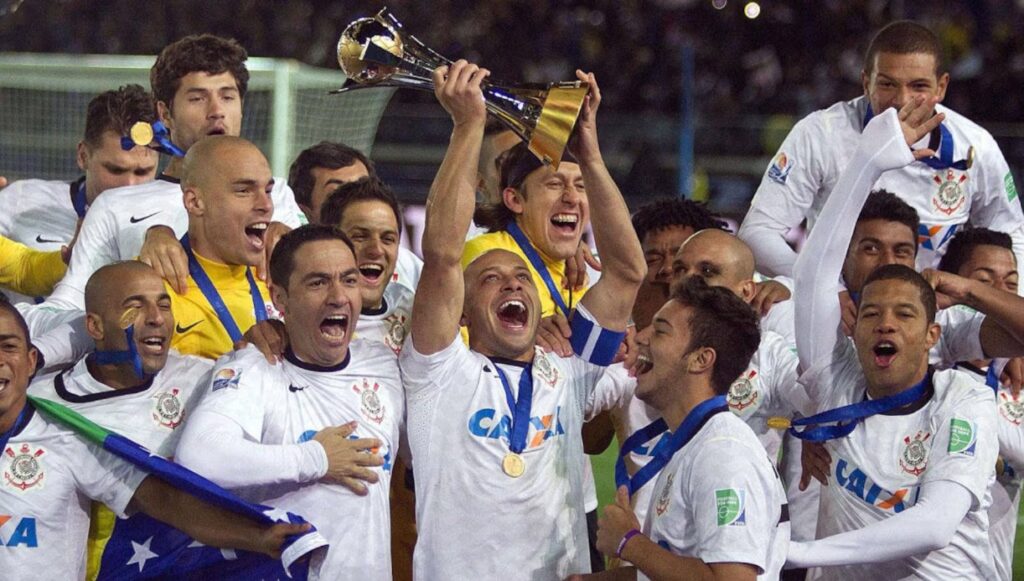
Corinthians players celebrate beating Chelsea 1-0 in the 2012 FIFA Club World Cup final in Japan (Photo: Daniel Augusto Jr./Agência Corinthians)
Sport Club Corinthians Paulista is far more than a football club. In Brazil, the black-and-white giants from São Paulo are widely seen as a social and cultural phenomenon, inspiring deep passion and tradition among their supporters in a country defined by football.
Founded on the streets of São Paulo on September 1, 1910, by a group of workers from the Bom Retiro neighbourhood in the city center, Corinthians was born with the humility of its founders and a spirit of resistance. At the time, football was considered an elite sport, and the club’s very existence challenged that notion.
Inspired by the visit of the English team Corinthian Football Club to Brazil in the early 20th century, the founders decided to create a club that would be accessible to everyone. From that idea came the nickname “Time do Povo” (The People’s Team), with working-class and popular roots that continue to shape Corinthians’ identity to this day.
The bond between the club and its supporters is a rare story of love and devotion. Corinthians fans are known as some of the most passionate and loudest in stadiums across the country. According to the latest Brazilian football census in 2025, the club boasts around 23 million supporters.
Fan passion, struggles, a long title drought, and the triumphs of the 1970s
Corinthians quickly carved out its place in São Paulo’s football scene in the early decades of the 20th century, becoming the most successful team in the Campeonato Paulista by the 1950s. After this golden spell, however, the club entered one of the most painful and emblematic periods in its history.
Between 1954 and 1977, the Fiel Torcida endured a 23-year title drought. Rather than weakening the club, this long wait only strengthened the unbreakable faith and loyalty of Corinthians supporters during years without silverware.
One of the defining moments of this era was the famous Invasão Corinthiana in 1976, when Corinthians fans flooded the Maracanã in Rio de Janeiro for the semifinals of the 1976 Brazilian Championship against Fluminense.
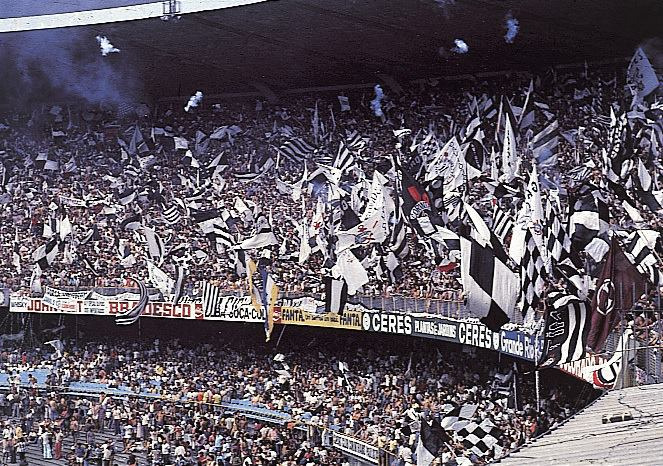
Over 60,000 fans travelled from São Paulo to Rio to watch Corinthians in 1976, in an episode known as “the Corinthians invasion” (Photo: Corinthians)
Estimates at the time suggest that around 65,000 supporters travelled roughly 550 kilometres from São Paulo to Rio, turning the iconic stadium into what felt like an extension of São Paulo itself. Although Corinthians did not reach the final, the moment is remembered as a symbolic victory and a powerful demonstration of the strength of the Fiel.
Redemption finally arrived in 1977, when Corinthians won the Campeonato Paulista against Ponte Preta. Basílio’s decisive goal ended the agonizing drought and turned the midfielder into one of the greatest idols in the club’s history, celebrated by fans to this day. The title celebration of 1977 remains unforgettable for generations of Corinthians supporters.
A winning philosophy: Democracia Corinthiana and the spirit of the 1980s
Between the end of the drought and the beginning of a new golden era, Corinthians led one of the most innovative and politically significant movements in world football history: Democracia Corinthiana.
Between 1982 and 1983, the initiative became a nationally recognized landmark, as stars like Sócrates, Wladimir, and Casagrande championed equal voting rights for all members of the club—players, coaching staff, directors, and employees—on internal decisions ranging from transfers to training schedules.
At a time when Brazil was still under a military dictatorship that had lasted more than two decades, Democracia Corinthiana became a powerful symbol of the fight for freedom, blending football, politics, and citizenship under the black-and-white banner.
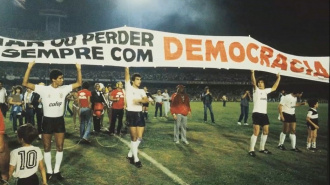
Corinthians players walk onto the pitch with a sign that reads ‘Win or lose, but always with democracy’ (Photo: Corinthians)
The golden era and conquering the world
Over the past three decades, Corinthians has firmly established itself as one of football’s great powerhouses. The club piled up trophies and earned respect on a global scale.
In the Campeonato Paulista, Corinthians is the most successful club in the competition’s history, with 31 titles—five more than its biggest rival, Palmeiras.
Between 1990 and 2017, the club dominated Brazilian football, winning seven national league titles in that span (1990, 1998, 1999, 2005, 2011, 2015, and 2017), cementing its status as one of the competition’s most successful teams.
The first FIFA Club World Championship, held in 2000, introduced Corinthians to the world as champions. Led by a squad filled with Brazilian icons such as Dida, Vampeta, Rincón, Marcelinho Carioca, Edílson, and Luizão, the team defeated Real Madrid in the semifinals and overcame Vasco da Gama in the final at the Maracanã.
The tournament also featured what many called a second Corinthians invasion, as around 40,000 fans from across Brazil travelled to Rio to watch the final.
In 2012, Corinthians finally achieved what many fans saw as the club’s greatest obsession: lifting the Copa Libertadores. The title came through an unbeaten campaign of seven wins and four draws, capped by a final against Argentina’s Boca Juniors.
Just months after conquering South America, Corinthians were crowned FIFA Club World Cup champions once again, defeating Chelsea and becoming the last South American club to win the global tournament.
Coached by the iconic Tite, the squad featured legendary figures such as goalkeeper Cássio, midfielder Paulinho, and striker Paolo Guerrero, the hero of both the semifinals and the final with the decisive goals.
The triumph in Japan showcased the power of Corinthians’ fanbase on the global stage, with around 30,000 supporters filling the stands in Yokohama.